Factors Affecting Demand – Determinants of Demand

Factors Affecting Demand

The following image depicts determinants of demand with their relations.

The factors affecting demand are:

  1. Price,
  2. Income,
  3. Tastes,
  4. Price of Related Goods,
  5. Consumers’ Expectations,
  6. Number of Buyers,
  7. Climatic Condition,
  8. Level of Economic Activity, and
  9. Miscellaneous Factors.

Now let’s discuss in detail each factor that influences demand.

1. Price

Price is the value of a product or service expressed in monetary terms.

In other words, the price is the amount of money whose payment is expected or required for buying a product or accessing a service.

A price of a product has a maximum effect on its demand.

If other factors remain constant (do not change) then the relationship between price and demand is as follows:

  1. If a product’s price is low, then its demand is high.
  2. If a product’s price is high, then there is a low demand for it.

Hence, it can be said that price and demand are inversely proportional to each other, provided other determinants remain constant or do not change.

In other words, if price increases then demand falls and vice-versa.

For example:

  1. If the price of nutritional and delicious Alphonso Mangoes falls then, people buy them in larger quantities.
  2. If the price of famous Alphonso Mangoes is higher than usual, then people prefer to buy them in smaller quantities.

Of all other factors, the price is the most important determinant that affects demand to a great extent.

2. Income

The income of an individual is his capacity to earn money.

A person with a higher income makes more money and vice-versa.

After the determinant of price, income is the second most significant factor that affects demand.

The relation between income and demand is as follows:

  1. If income is high, then demand is also high.
  2. If income is low, then demand is minimum.

So, we can say, income is directly proportional to demand.

In other words:

  1. If the income of people is high, then the demand generated by them is also high.
  2. If the income of people is low, then the demand generated by them is minimum.

For example:

  1. A high-income group demands more goods in larger quantities.
  2. A low-income group demands fewer goods in smaller amounts.

3. Tastes

Tastes, Preferences, Habits, Fashion, and Popularity, also have an impact on the demand.

Tastes of people i.e. their likes and dislikes affect demand:

  1. If people like a product, then its demand is high even when charged at higher prices.
  2. If people dislike a product, then its demand is low even when charged at lower prices.

For example:

  1. People admire, love, and prefer using Apple’s iPhone and iPad even though they are a bit more expensive than other smartphones and tablets.
  2. People dislike buying fake perfumes and don’t prefer wearing them even though they are many times cheaper than original brands.

Fashion or current trend in the market has an impact on the demand for a type of product. For example, now, the young generation in India prefers to wear fashionable and comfortable western apparel over traditional and cheaper Indian clothes.

Popularity or fame also affects the demand for a product. For example, people prefer to buy regularly advertised and popular branded products over lesser-known alternatives.

Note:

  1. It is quite essential to know that factors like tastes, habits, preferences, fashion, popularity, etc., raise a product’s demand even when its price is higher.
  2. In other words, these determinants are exceptions and don’t satisfy the inverse relationship between price and demand.
  3. Hence, they are assumed as constant (i.e. they don’t change) while stating the law of demand.

4. Price of Related Goods

Related Goods exhibit some relationship with each other.

These are of two types:

  1. Substitute Goods, and
  2. Complementary Goods.

Substitute Goods are products that can easily replace each other. That is, they can take each other’s place. In other words, they act as an alternative to each other to satisfy a similar want or desire. They are even called Supplementary Goods because they readily supplement each other’s role or function just in case of unavailability, scarcity, higher market price, etc.

For example, Tea and Coffee substitute each other. When the Tea is unavailable, the nearest possible alternative most people would choose is Coffee and vice-versa.

The fluctuations witnessed in the prices of substitute goods (like Tea and Coffee) also affect their demand.

For example:

  1. If the price of Tea (Substitute Goods No.1) decreases whereas the price of Coffee (Substitute Goods No.2) increases, then the demand for Tea increases, and that of Coffee falls.
  2. In other words, the Price of Tea is directly proportional to the Demand for Coffee.

Hence, we can conclude, the Price of Substitute Goods No.1 (Tea) is directly proportional to the Demand for Substitute Goods No.2 (Coffee).

Two or more goods used together in a combination to satisfy a given want are called Complementary Goods.

Examples of Complementary Goods:

  1. Petrol and Cars,
  2. Electricity and Air Conditioners, so on.

When the price of Petrol (commodity) falls, then the demand for Cars (its complementary product) increases.

Similarly, when the price of Electricity (commodity) falls, then the demand for energy-hungry Air-Conditioner (its complementary product) increases.

So, we can conclude, that the price of a commodity is inversely proportional to the demand of its complementary product.

In other words, if the price of a commodity decreases then the demand of its complementary product increases and vice-versa.

5. Consumers’ Expectations

Consumers’ expectations arise out of their predictions about:

  1. Future Price, and
  2. Future Income.

If there is an expectation of a rise in the future price of an essential commodity, then current demand for it increases.

For example, due to inadequate rainfall people start buying and stocking more food grains like rice with a fear to avoid future price rises due to poor yield and scarcity. Such behavior raises their current demand for food grains in the market.

If consumers are expecting a fall in the future price of an essential commodity, then current demand for it will also fall.

For example, if people are hoping that the gold prices will fall soon then they will postpone their decision to buy gold. This expectation will drastically reduce their current demand for gold in the market.

If consumers are expecting a rise in their future income, then their current demand will increase.

Consider, for example, if the government announces a massive reduction in the percentage of taxes levied, then people won’t have to pay more in the future. It will save them more money. In other words, they would soon expect a rise in their regular income. This expected income boost would compel them to make pre-orders or buy their desired goods on installments. Thus, it will increase their current demand in the market.

If consumers are expecting a fall in their future income, then their current demand will decrease.

For example, if there is fear of massive layoffs due to an upcoming recession or downfall of the economy then people stop spending more to prepare and save money for future uncertainties. Thus, it will decrease their current demand in the market.

6. Number of Buyers

The number of buyers or consumers’ population is another determinant of demand:

  1. If buyers are more, then their demand will also be more.
  2. If buyers are few, then their demand will also be small.

So, the population of consumers is directly proportional to the demand they generate in the market.

For example, with growing middle-class families the demand for affordable sedan cars is equally rising.

7. Climatic Condition

The climatic condition or weather of an area is also a determinant of demand.

For example:

  1. In colder regions, there is a high demand for woolen clothes.
  2. In hotter areas, there is more demand for cotton clothes.

8. Level of Economic Activity

The level of economic activity is a determinant of demand:

  1. A high level of economic activity usually comprises huge investments in infrastructure development, a high rate of employment, high consumption power, a rising standard of living for people, etc. It increases demand.
  2. Contrarily, a low level of economic activity displays characteristics like a lack of investments, an increase in the unemployment rate, low purchasing power, plunging living standards of people, and so on. It decreases demand.

If economic activity increases, demand also increases and vice-versa.

Hence, we can conclude, the level of economic activity is directly proportional to the demand.

9. Miscellaneous Factors

Apart from the above major determinants, the following factors also affect demand:

  • Advertisements,
  • Government Policies,
  • Special occasions like festivals, events, etc.
  • Consumers Satisfaction,
  • Quality of a product or service,
  • Population growth whether rising or declining,
  • Age of population whether young or old,
  • Socio-cultural attitudes and mindset,
  • Ease of accessibility to a particular product or service,
  • Market size, and so on.

Zig Zag Indicator: About, Strategy, Settings, Formula & Limitations

Zig Zag Indicator

Forex trade has become popular than ever before. Many people are now going into forex, with some making millions in the forex market, while others are losing their hard-earned money in the forex market due to its volatile nature.

Many tools and AI robots that give forex signals have been developed. One of such tools is the Zigzag indicator and we’ll be taking you through the basic things you need to know about Zig Zag Indicator.

About Zig Zag Indicator

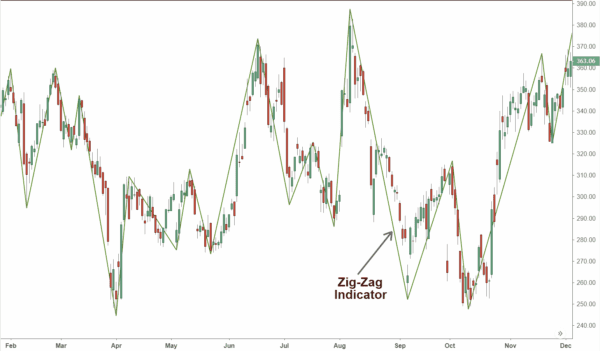
A Zig Zag indicator is a tool that indicates and gives you a complete view of the forex market prices on some different time frames with a zigzag pattern. You can swing trade and do any type of trade you want to do.

If you notice the movement of markets and prices, you will see that markets don’t move straight up and they don’t move down straight. Price swings up and down in a zigzag pattern.

The Zig Zag indicator is one of the few technical indicators that measures the high swings and the low swings in the market. With the measurement, you can know accurately the market low and high points so that you can know what you will trade in the market.

The zigzag tool filters noise in the market and clear your doubts.

Zig Zag Indicator Strategy

The most interesting feature of the Zig Zag indicator is the ability of the tool to filter out little price movements that happen with a trend (noise).

The zigzag indicator helps traders to maintain a steady and profitable position throughout a particular trade trend.

The Zig Zag indicator create lines or pattern of trends on a chart. Adjustment is only made when the movement of above 5% is made. The Zig Zag indicator will never register or indicate any little fluctuation in price that is less than 5%.

Zig Zag Indicator Settings

I will tell you the settings you need to do so that you can set up your Zig Zag tool for trading.

The steps are listed below:

First, set the Zigzag indicator setting at 20depth and 5% deviation. This is important because we want to be sure that the ZigZag tool shows us the most serious high swing and the swing low points in the forex market.

This is because we have to use a minimum of 20 trading periods for the Depth and 5% deviation so we can see accurately the full display of the swings in the market.

ZigZag Indicator Settings at 20 for The Depth and 5% Deviation

First, we want to make sure the ZigZag tool only shows us the more significant swing high and swing low points in the market. For this, we have to use at least 20 periods for the Depth and 5% deviation to accurately display the market swings.

  • Plot the Fibonacci line once you see that the first two swings are fully established. You need just 3 reference points before you can plot or draw the Fibonacci extension line.
  • As soon as the first two swings are established, you will see three reference points we will use in drawing our Fibonacci extension line.

The Zig Zag indicator will only help us to mark the swing low that it is formed too late for you to use and base your trades on it. It will help us to know when the zigzag pattern is about to end.

  • Wait for the 3rd swing to stop between 0.618 to 0.786 or 1.0 to 1.272. Since we don’t know when a particular trend will terminate, we are going to use the step#4 method to spot the next swing point in the market.
  • Wait till you have a candle with a little bit higher low on the right side and the left side. The bar from the right must break above the bar on the left side.

With this 3 bar pattern, you can spot the next market swing point easily.

You just need to wait till you have a candle that has a higher low on the left and the right-hand side. For us to confirm this three-bar pattern we also need the bar that is at the right side to break above the high of the left bar.

Zig Zag Indicator Formula

ZigZag (HL,% change=X, retrace=FALSE,

Last Extreme = TRUE)

If % change>=X, plot ZigZag

where:

  • HL = High-Low price series or Closing price series
  • %change = Minimum price movement, in percentage
  • Retrace = Is change a retracement of the previous move or an absolute change from peak to trough?
  • Last Extreme = If the extreme price is the same over multiple periods, is the extreme price the first or last observation?​

Source: investopedia.com

How To Calculate the Zig Zag Indicator

  1. Select a starting point (swing high or swing low).
  2. Select % price movement.
  3. Identify the next swing high or swing low that differs from the starting point = > % price movement.
  4. Draw trendline from starting point to new point.
  5. Identify the next swing high or swing low that differs from the new point = > % price movement.
  6. Draw trendline.
  7. Repeat to most recent swing high or swing low.

Zig Zag Indicator Limitations

Similar to other trend-following indicators like Aligator Indicator, CCT indicator, MACD, etc., buy and sell signals depend on the past price history that may not be predictive of future price action. For instance, an integral part of a trend may have already occurred when a Zig Zag line finally appears.

Traders should note that the most current Zig Zag line may not be permanent. When the price changes direction, the zig zag indicator begins to draw a new line.

If that line does not get to the indicator’s percentage setting and the price of the security changes direction, the line is removed and substituted by an extended Zig Zag line in the trend’s original direction.

With these in mind, many traders use the Zig Zag indicator to check the direction of the trend instead of trying to time a perfect entry or exit.

Questions and Answers about Zigzag Indicator

There are some questions you might have about some terms In Zig Zag which you might not have heard before.

  1. Depth: Depth in Zig Zag indicator means how far in the chart bar it will look like
  2. Deviation: this means the percentage of deviation before the trend is reversed and a Zig becomes a Zag.

Other Trading Indicators

There are other trading indicators apart from Zig Zag indicators they are CCI, Willam fracture alligator, MACD signal. We are going to discuss briefly some of them.

Alligator indicator

The Alligator indicator is another trading indicator you need to know about. The alligator indicator works by drawing different Moving Averages (MAs) on a bar chart. The alligator indicator has an alligator shape. It has 3 averages that are always moving. It has 3 colours, and each colour has its own representation of a part of an alligator animal and its connotative meaning.

The blue line represents the Jaw of the alligator, the red line represents the teeth and the green line represents the lips. These 3 colours are the only customized colours on the trading platform.

The colours are explained below:

When the alligator’s lips, teeth, and jaw are closed (which is when the moving average lines are intersected) it means the indicator Is tired or is on recess. That is the major reason most forex traders are always taking a position like that in the market because it is a weak trend.

Some traders like closing their position whenever they are making profits, this is when the alligator uncrosses its lines by opening its jaw and moving forward and backward.

CCI indication

This stands for Commodity Channel Index is a forex indicator that measured the existing price level relative to the average price level over some time. The CCI has a momentum oscillator which makes the CCI identify overbought and oversold levels for you.

William Fractal

This is a forex trade indicator that was created and built by a man named Bill Willams which enables you to detect the reverse points (high and low swings in the market trend) with pointers. Up fractal and down fractals have different shapes that have marks that differentiate them. The William Fractal helps its users determine the direction of the price will move in the future.

MACD

Moving average convergence divergence (MACD) is an indicator that follows trend momentum. It shows the relationship between two moving security prices. You can buy when the MACD crosses over its signal line and sell when the MACD crosses below the signal line

Conclusion

In conclusion, you have seen how you can trade forex with the Zig Zag indicator. It gives a complete view of the market at a particular time. It shows you the future analysis and indication of the future movements in the forex market

You can also try the alternative forex indicators like CCI and William Fracture indicators that will help you with the future indication of prices so that you can make profits from your forex trading.

You should note that Forex is a very risky business which means you have to be careful while trading with any of the indicators in this post. Make sure you have a comprehensive technical analysis before you trade using any indicator so as not to lose all your trades due to your ignorance of the market trends or forex indicators.

Also, don’t put all your eggs in one basket, always trade with the amount of money you can afford to lose so that you wouldn’t end up in debt.

Lastly, do check out the blog page for more articles like this.