
The 9 Benefits of Delegation in Workplace

Delegation

Delegation is the act of assigning tasks or responsibilities to a person or group other than oneself. It is also the granting of authority to another person to act on one’s behalf.

Delegation is a management strategy that allows an organization’s human resources to be used efficiently and effectively, by dividing work into individual tasks and assigning those tasks to employees. Delegation can help increase productivity, reduce errors, and promote creativity.

The benefits of delegation are many: it can reduce stress levels for managers and employees alike; it can improve employee morale by giving them more responsibility; it can increase employee engagement by allowing them to work more closely with others in their team; it can lead to better results because people are more invested in their work when they have ownership over what they do.

1. Delegation helps Superior focus on Challenging Jobs

Under delegation, a superior (boss) delegates his less important duties, routine tasks, and monotonous work to his subordinate (junior). He can then use some of his available free time to focus on other significant matters, important assignments, and challenging jobs that are in pending. It saves his precious time and makes him more productive and efficient towards his job commitment. This overall benefits the performance of the organization.

- Advertisement -

2. Delegation leads to Quicker Decisions and Actions

If there is a delegation of authority, it helps to make quick decisions and actions. It is so since; precious time is not wasted or lost in repetitively consulting the superior on routine matters. A subordinate is free to act within the limits of his delegated authority and there is no need to ask a superior again and again. It speeds up the decision-making and task execution.

3. Delegation Trains, Develops, and Prepares Juniors

Delegation sets up a training and development platform for juniors. It gives them the opportunity and freedom to tackle challenging tasks. It helps them to take decisions and actions. It also helps them to earn a valuable experience from the work. It prepares them to face confidently newer challenges in the future. This overall enhances and develops their set of skills needed for a successful career.

4. Delegation Boosts Morale of Juniors

When there is a delegation of authority, the subordinate gets a chance to prove his abilities to his superior. He sincerely starts working hard to accomplish the task delegated to him. After completing the assigned work, if he manages to impress his boss, it automatically raises his confidence or morale. He soon starts trusting more of his abilities (skills). He also tries to give his best job performance. This overall improves his feelings not only towards his superior but also towards work and the organization.

5. Delegation Motivates Subordinates

The delegation is necessary as it acts as a factor of motivation for subordinates. When a superior praises his junior for properly doing delegated work, it motivates him. It makes him feel good about himself. It stimulates him and makes him ready to give his best for the next upcoming task. It makes him more productive and efficient to even handle a difficult job. It inspires him to keep improving his skills. Motivated employees bring success to the organization.

- Advertisement -

6. Delegation Leads to Better Results

In delegation, the superior is not consulted again and again by his subordinate on matters already delegated. Instead, the subordinate has full authority to handle an assigned task as per his ability. He is free to take decisions without regularly receiving confirmation from the boss. Since decisions are made only by those who perform the job, a lot of time is saved and the communication gap is minimized. Quick decisions improve performance and eventually leads to better results as expected by the organization.

7. Delegation Improves Superior-Subordinate Relationship

When a superior delegates authority, it indicates that he trusts and understands the potential of his subordinate to handle and complete a particular task. When a junior completes the assigned work as per expectations, it shows that he clearly knows the requirements of his boss. Thus, the act of delegation helps them understand each other and contributes towards improving their relationship.

8. Delegation Develops a Team Spirit

Delegation develops a team spirit in the organization. It enables the superior and his subordinate to work together as a team. Superior leads the team like a captain by delegating smaller chunks of duties. Whereas, the junior accomplishes the assigned jobs like a sincere and disciplined soldier. This overall results in higher efficiency, productivity, and profitability.

9. Delegation is Key to Successful Organisation

Within an organization, delegation brings people together. It helps them to share responsibilities for achieving a common goal. It maintains their interest and enthusiasm. It enhances their leadership skills. It gives them work satisfaction. It helps them see each other develop and grow. It creates a progressive environment in the organization. Without it, people won’t come together and remain isolated from each other. Therefore, it is the key to a successful institution.
- Advertisement -

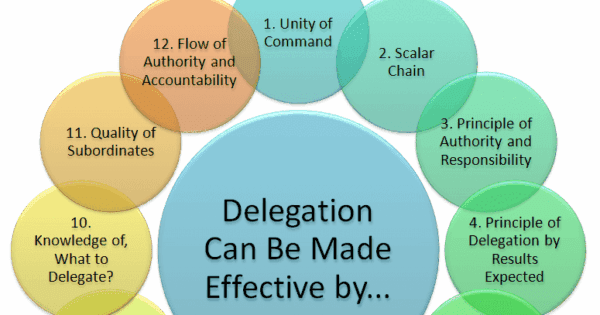
12 Steps to Make Delegation Tasks Effective

1652038488 How To Make Delegation Effective.png

Delegation tasks are a great way to give employees more responsibility and ownership of their work. However, there are many different ways that this can be done. If you want to delegate tasks effectively, you need to first understand what the person is capable of and then find the right task for them. This will allow them to do their work faster and better while also giving them a sense of responsibility.

Now let’s discuss how to make delegation effective.

1. Unity of Command

Only one superior should give orders to his subordinate. If there are more than one superior for each subordinate, it will create a lot of confusion, chaos, conflict, and disorder within the organization. The junior won’t understand whose order to follow and whom to report their difficulties. It will negatively impact the discipline, efficiency, and productivity of the institution.

Therefore, unity of command must be maintained to make delegation efficient and functional.

2. Scalar Chain

The line of authority from superiors to subordinates must be crystal clear throughout the organization. In other words, every junior should know who is his superior (or boss) and under whom he is working. He should also know who delegates authority to him. He should be aware of whom to contact if there arise any work-related problems or difficulties.

So, a scalar chain is necessary for effective delegation.

3. Principle of Authority and Responsibility

Authority and responsibility go hand in hand with each other. They are two different sides of the same coin. They are inseparable from each other. When a person gets authority, he should also be made aware of his prime responsibility. Authority without any reasonable responsibility is a risky affair and is venerable to being misused optimally by unscrupulous individuals.

- Advertisement -

This principle protects such abuse of authority and makes delegation effective through responsibility.

4. Principle of Delegation by Results Expected

The delegation of duty to a subordinate should be done only according to the results expected from him. He should not be assigned work that is way beyond his abilities. He should be given only work that suits his expertise, interest, and capacity. Superior should take care to see that his subordinate is aware of the assigned job’s goal, works efficiently, and is capable of giving expected results on time.

Hence, delegation can be made effective by assigning work to only those juniors who can give the expected results.

5. Principle of Absoluteness of Responsibility

Unlike authority, the responsibility cannot be delegated. It is not shareable and remains only with the superior. He is held accountable not only for his work but also for the work of his subordinates.

Therefore, care must be taken while delegating important duties to the juniors.

The act of delegation is a serious step and, therefore, must be done with utmost care.

Before delegating duties, care must be taken to consider prior all possible future outcomes.

Thus, the principle of absoluteness of responsibility binds the superior to delegate with caution. This alertness on his behalf makes the process of delegation effective.

6. Principle of Functional Department

The institution should get organized into different functional departments or units. The duties, responsibilities, and authorities of each department must be well-defined. There should be no confusion or conflict regarding which department should handle a particular work and which not.

- Advertisement -

If departmentalization is successful only then delegation will be efficient.

7. Proper Motivation

Delegation adds up to the workload on the subordinate. Here, along with doing his regular job, he is ordered to do an additional task. The new responsibility puts mental stress and physical pressure on him. It can ultimately demotivate him and affect his job performance. The demotivation can be prevented by releasing appropriate incentives on time. He should be given some additional perks, bonuses, status, promotions, rewards, etc. to keep him motivated.

Hence, the proper motivation of subordinates makes delegation a more result-oriented endeavor.

8. Proper Training

The delegation of authority is not a simple task. It demands judgment, trust, responsibility, and a good experience.

If authority gets delegated to an incapable subordinate, it might not give the expected results. It will not only lead to a waste of productive time and resources but will also demotivate a hardworking subordinate.

Therefore, training becomes a necessity.

Proper training should be given to both superiors as well as subordinates:

  1. The superiors should be trained well to delegate, direct, communicate, control, etc.
  2. Similarly, the juniors too should be trained in job techniques, leadership qualities, building self-confidence, so on.

So, training empowers the act of delegation to function efficiently.

9. Active Control System

The delegation will be effective only when the control system remains active.

In other words, the superior must never let go of his control on the work delegated to a subordinate.

Superior must keep a regular check on how the authority is being used by his subordinate. He must routinely access the actual performance and progress of the subordinate with the help of some pre-determined standards.

  1. If the assigned work’s progress is within expectations, the delegation shall be continued.
  2. If there are minor variations in work progress, then corrective measures should be suggested.
  3. If deviations are major and a matter of concern, it would be better to discontinue the delegation and seek someone else who is more capable of doing the same work.

Only such a strict control system will improve the effectiveness of delegation.

10. Knowledge of What to Delegate?

The superior should be smart and experienced enough to figure out what to and what not to delegate:

  1. He must always keep a valuable and sensitive workload for himself. For example, he should personally handle important matters related to planning, coordinating, and controlling.
  2. He should delegate only the unimportant, routine and monotonous nature of work to his subordinate.

This knowledge will certainly improve the effectiveness of delegation.

11. Quality of Subordinates

Before delegating, the qualities of a subordinate must be considered.

He should be:

  • Mature,
  • Trustworthy,
  • Sincere,
  • Obedient,
  • Experienced,
  • Skillful,
  • Punctual,
  • Hardworking,
  • Stress handler,
  • Responsible,
  • Result-oriented,
  • Committed to his duties, etc.

If he has the above merits, he is then suitable for a delegation of authority from his superior.

Therefore, choosing the right subordinate or junior is important to enhance the effectiveness of delegation.

12. Flow of Authority and Accountability

The superior always delegates authority to his subordinate. In other words, the authority always flows in a downward direction. On the other hand, the subordinate is accountable to his superior. It means the accountability flow in the upward direction.

- Advertisement -

People involved in the process of delegation should know this flow to improve its functionality or effectiveness.