Best Life Insurance: a Comprehensive Look at Its Meaning and Importance

planning secure future financial

Most individuals go through a significant portion of their adult lives without considering life insurance. We all understand the discomfort of facing our own mortality, but the alternative is even more daunting. The thought of navigating life without any concrete plans for the well-being of our loved ones after we’re gone is truly terrifying. Life insurance is specifically designed to protect your loved ones and dependents in the event of your passing. It provides a payout to your designated beneficiaries. Over time, life insurance policies have expanded to offer options for generating money and acquiring assets without incurring taxes. My recommendation is to invest in life insurance while you’re young and the premiums are affordable, rather than waiting for a tragedy to strike. Before delving into the reasons why life insurance is a valuable investment, here’s a helpful video to give you a better understanding of it.

What is Life Insurance?

Typically, people only consider their financial affairs in terms of life and death when they have families. However, I’m here to tell you that purchasing life insurance is the best decision you can make for yourself. Getting life insurance before starting a family or establishing a business allows you to secure a more affordable policy. So, how does it work? In exchange for your premium payments, your insurance provider offers a lump-sum payment, known as a death benefit, to your chosen beneficiaries. These can be authorized individuals who will receive the payout upon your passing. The amount of the annual premiums you pay depends on the terms of your policy. If you, as the primary beneficiary, die before the policy term (typically 20 years), your family will receive the specified payout. This payout can help cover funeral expenses, debts, and property costs after your passing. For more detailed information, Investopedia provides further insights into how life insurance works.

Naturally, before making such a significant commitment, you’ll want to fully understand all aspects of life insurance. To begin with, there are certain factors to consider that will help you assess your coverage needs.

The coverage you receive will depend on:

  • Your reasons for obtaining life insurance (asset accumulation, wealth protection, family coverage, etc.)
  • Your life stage (married, in school, starting a business)
  • Your age

Over time, you’ll gain peace of mind knowing that your dependents will be taken care of, even when you’re no longer here.

6 Important Reasons You Need Life Insurance

As I matured and started my own business, I realized that I would eventually want to get married and have a family. All of these milestones required a solid financial plan to ensure both my short-term and long-term goals could be achieved. Here are some key reasons that helped me make the commitment to life insurance:

- Advertisement -

1. You Never Know: Death is unpredictable. You could go to sleep one night and never wake up. As frightening as that sounds, life insurance helps provide the necessary financial support for your family to cover outstanding payments, mortgages, and even school tuition in your absence.

coffin bearer carrying casket fu

2. To Leave An Inheritance: Offering your family financial peace of mind during the mourning process is crucial. By designating your family as beneficiaries, even if you have no other substantial wealth, you can leave them something valuable. This ensures that your children’s future financial needs are taken care of, including providing them with a quality education.

planning secure future financial

3. To Pay Off Debts: Debts can be overwhelming to handle, especially when combined with the burden of your absence. Life insurance alleviates this concern by allowing your loved ones to pay off any outstanding debts you may have, such as mortgages and student loans.

young woman using smart phone ch

4. You Have a High-Risk Lifestyle: If, like me, you engage in hobbies or have a job that exposes you to more risks than the average person, life insurance provides peace of mind. It allows you to fully enjoy the thrills of life, knowing that the next generation will be taken care of in case of any unfortunate events.

- Advertisement -
concept solution domino effect s

5. Burials Aren’t Cheap: Just because you’ve completed your journey on this earth doesn’t mean you should burden your family with the responsibility of paying for your funeral expenses. Life insurance ensures that your family can mourn in peace by providing the necessary finances to cover funeral costs.

bereavement 1239415 480

6. You Have a Business: Life insurance is not only beneficial for individuals; it can also safeguard businesses from financial distress, liability, or instability in the event of an owner or partner’s death. In such cases, you may need to buy out the deceased partner’s share to keep the business running smoothly. Life insurance also serves as a reliable means to protect and accumulate assets, enabling you to leave behind financial security for your family. Entrepreneurs particularly benefit from life insurance as a safety net to pay employees or shareholders in case they are unable to.

hands holding piece blank jigsaw

Who Needs Life Insurance?

Life insurance is not only necessary for heads of families with dependents. Various factors influence whether individuals should obtain life cover, as outlined by Forbes. Although it is recommended for everyone, there are specific situations where life insurance becomes an urgent necessity. Consider the following list to determine if it’s time to consult a financial advisor:

who needs life insurance

1. New Families

Starting a family is a significant step, and it’s important to approach the responsibility with a solid long-term financial plan. Investing in life insurance before marriage will be more affordable, as there will be fewer dependents initially. If you plan to have children, there will come a time when you and your spouse may need to take leave to care for the baby. In such cases, having a sound financial plan becomes essential.

- Advertisement -

2. Individuals with Dependents

If you already have a family that relies on you financially, obtaining life insurance is crucial. This extends beyond your immediate family to include individuals like housekeepers or caregivers who have become part of your family. It may be difficult to find suitable replacements for them, so securing their financial well-being is of utmost importance.

3. Young Singles

Even as a bachelor(ette), there may be people affected by your death, so it’s essential to have a plan in place to cover your burial costs. Taking proactive steps in advance ensures that you will have a dignified funeral. Additionally, life insurance for single individuals is relatively inexpensive as they are typically in good health.

4. Individuals in Debt

If you are in the midst of repaying significant debts, you do not want to burden your family with inheriting your financial obligations. Whether it’s a mortgage, student loan, or car loan, life insurance provides financial security for both you and your loved ones. Your estate won’t have to be liquidated in your absence, and your family can have peace of mind.

5. Childless Couples

If your partner passes away suddenly, their life insurance can supplement their lost salary, enabling you to maintain your current standard of living. Even if the surviving partner has a substantial income, they may still need assistance with funeral expenses.

- Advertisement -

6. Employed Individuals

Your job may offer some form of life insurance coverage, but often, it may not be sufficient, and additional coverage may be necessary. Furthermore, job circumstances can change, such as unemployment or changing employers, so having non-conditional coverage is essential.

7. Entrepreneurs

Whether you own a business or hold shares in a company, obtaining separate life insurance coverage for your investment is wise. Businesses can be volatile, and protecting your business obligations in the event of a partner’s death or withdrawal is crucial.

8. Individuals Dependent on Parents

This is more common than you might think. Many people take out insurance policies on their parents to ensure they receive payouts when their parents pass away. By including yourself as a dependent on their policy, you can safeguard your stake in the coverage. You can also find solace in knowing that you’ll be able to give your parents a dignified burial. Additionally, as age advances, health issues tend to arise, which can become a financial burden. Obtaining life insurance, as stated by Business Insider, gives you the peace of mind that everything will be taken care of.

9. Life Insurance for Children

Despite not having any dependents, there are numerous reasons why purchasing life insurance for your children is beneficial. Children often fall ill, and some families may struggle to afford medical expenses. Life insurance for children can provide financial support during these difficult times. Additionally, securing coverage at a young age ensures that they have protection for years to come.

- Advertisement -

10. Preparing For Retirement 

Death isn’t the worst thing that could happen to you. You could live to a ripe old age and find that you can’t work and so need to have a reliable income for your upkeep. Ideally, you’d have started saving early for your senior years, but if you didn’t, it’s still possible to get cover that old. You likely won’t have any dependents at that point and just need to make sure you prepare for your burial. I’ll remind you that it’ll be costly because of all the health problems that ensure with age.

With that being said, the amount of coverage a person needs isn’t a straight answer. The variables that apply to your situation affect your needs, from age, to gender, and social status. So take everything into account and also consider how much you can afford and reach out to an insurance representative to help you calculate your needs.

Different Types of Life Insurance

As you may have guessed, life cover comes in many variations to incorporate the different needs various customers have. The insurance industry continually strives to provide tailored covers for its customers. In light of this, allow me to help you break down what they are and what each policy offers:

  • Term Life Insurance

This remains functional within a restricted time frame. Your beneficiaries receive a settlement if your death occurs within this period.

If you live longer than the length of the agreement, your insurance expires, and you receive no payout. Very few insurers allow you to change and redeem it as a full life cover without you running a loss.

- Advertisement -

Usually, the fee isn’t fixed and may change over the years. Term Life cover benefits include more massive payouts for your dependents. It’s also less expensive than other alternatives.

Within term life, different versions like Group Term Life are offered by companies for their employees. Another type is Supplemental Life Insurance which consists of untimely death and dislocation cover.

  • Permanent Life Insurance

With this type of insurance, your coverage never expires. This comes in several variations, from whole life insurance to universal life cover.

  1. Whole life insurance covers you for your entire life and pays a settlement when you die for your loved ones. The premiums you’ll pay are fixed when you get the cover, so you’ll pay the same amount for as long as you live. Your health and youth work in your favor here since your charges will be cheap.
  2. Universal life cover, on the other hand, affords you more flexibility when it comes to your charges and premiums. Policyholders here can adjust the cost schedule of their payments after making the first payment. This way, you can grow your stake while simultaneously maintaining a life cover.
  3. A branch called indexed universal life insurance allows customers to reduce their charges to a stable account. This is a secure investment that isn’t influenced by inflation or economic changes.
  4. Joint or Survivorship life cover is for couples that decide to get a policy together in structured first-to-go or second-to-go coverages.

With the first, a settlement is made after the first party’s death to the named beneficiaries. The second only kicks in after both parties have died, and are commonly used with mortgages in mind.

  1. Variable life insurance is often viewed as a perennial life cover with an endowment factor. The cover’s worth is invested in branch accounts that can accumulate interest as the accounts expand.
  2. Mortgage life insurance functions like the rest, only there’s no specified beneficiary, the payout is made to your homeowner’s loan usurer. So even if you pass on, your house debt will be settled.
  3. If your beneficiary dies, Dependent Life Insurance pays out to you to help with funeral costs. The payout is minimal and covers “separated” spouses, older children, stepkids, or adopted kids.
  4. Final expense life insurance is made to settle hospital and burial costs after you’re gone. It’s also known as burial insurance and pays explicitly for your funeral since these are quite expensive

Figuring out that you need life insurance is the first step. Now that you’ve learned a little more about all the different types of insurance, things should be a little less confusing. We’re here to help you break through the clutter and learn more about the most popular kinds of life insurance, so you can decide what’s best for you.

- Advertisement -

Final Word

One of life’s most uncompromising truths is that we’ll all die at some point. So the best you can do is to ensure that when your time comes, you’ve prepared sufficiently not to leave your loved ones to suffer.

With Life insurance, you can help care for your family beyond your grave, allowing them to grieve you peacefully. So take the step to prepare for the unknown future and get inspired today.

We’d love to hear from you if there’s something you need us to compare among these insurance giants. 

Reasons Why You Should Get a Life Insurance: a Breakdown

life insurance

Most people go through years of their adult life without ever thinking about life insurance. We all understand the burden of contemplating our lives ending; however, the alternative is worse. Going through life without any concrete plans on how your loved ones will be taken care of when you’re no longer on earth is a scarier thought.

Life insurance is tailored to shelter your loved ones and your dependents if you pass on. They make a deceased benefit payout to your registered grantees. With time, lifetime covers have expanded to offer options that allow you to generate money and duty-free assets. My advice would be to invest in life insurance while you’re still young, and it’s cheap, without waiting for calamities to befall you.

Before breaking down why life insurance is a worthwhile investment, here’s a video to get you acquainted.

What is Life Insurance?

More often than not, people only think about their financial affairs in terms of life and death when they have families. I’m here to tell you that the best decision you can make for yourself is to purchase life cover today. Investing in lifetime cover before starting a family or building your business means you’ll get a cheaper deal.

So how does it work?  In correspondence with your premium payments, your insurer offers a lump-sum settlement ( a death benefit) to beneficiaries. These may be authorized people that will get the payout in the event of your passing. The yearly premiums you pay depend on the agreement you have with your insurer for the full “term” of your policy. 

- Advertisement -

If you, as the primary beneficiary, die before the policy term (usually 20 years), then your family collects the indicated payout.

This payout helps cover funeral costs, debts, and property charges when you’re deceased. Investopedia sheds more light on how this works.

Understandably, before taking this big step, you’ll want to know all there is about life insurance. For starters, there are factors to consider that’ll help you assess your coverage needs.

The coverage you get will depend on:

  1. Your reasons for getting life insurance (assets accumulation, wealth protection, family cover e.t.c.)
  2. Where you are in life (married, in school, starting a company)
  3. Your age

Over the years, you’ll get peace of mind knowing that your dependents will be taken care of, even when you’re no longer around. 

6 Important Reasons You Need Life Insurance

As I grew older and started my business, I realized I’d want to get married and have a family someday. All these steps required me to have a solid financial plan to make sure my short and long-term plans would be fulfilled. Here’s a list that helped me make that insurance commitment:

HOT READ: 10 Best Insurance Companies in Dubai You Need to Try in 2026

1. You Never Know

7 ngcb19

Death is unpredictable. You could go to sleep and never wake up, scary as that sounds. Life insurance assists those you leave behind in covering due payments and mortgages in your absence. The duty-free payout helps them pay for school tuition as well. 

So as your final gift to them, take measures to care for your family in the face of one of life’s tragedies.

2. To Leave An Inheritance

8 ngcb19

The gift of financial peace of mind while mourning your passing is an important one. Signing your family up as beneficiaries allows you to leave something for them, even if you have no other wealth. That way, your children’s financial needs in the future will be taken care of, and they can get a quality education.

- Advertisement -

3. To Pay Off Debts

9 ngcb19

Debts are a huge encumberment to handle, especially when clashing with the strain your absence will bring.

You don’t want to leave your family with debts to pay off, and that’s why life insurance is essential. Taking out life cover allows those you leave behind to settle any outstanding payments you may have. Things like mortgages and student loans will be paid off by your life cover.

4. You Have a High-Risk Lifestyle

10 ngcb19

If you’re like me, then your chosen hobbies (or job) may expose you to more dangers than the average person. Taking life cover allows you to enjoy the thrills of life with the assurance that the next generation will be taken care of.

5. Burials Aren’t Cheap

11 ngcb19

Just because you’ve finished your race on earth doesn’t mean that you should leave the responsibility of your funeral to your family. In a challenging and emotionally stressful period of their life, this insurance finances the funeral so your family can mourn in peace.

6. You Have a Business.

12 ngcb19

Life Insurance doesn’t just cover individuals; businesses can also be protected from financial troubles, accountability, or imbalance if the owner/partner dies. In such a case; you may need to buy out the partner that’s deceased to keep the business going.

- Advertisement -

Whether supplying essential temporary loans or maintaining operations until things subside, life cover has an invaluable role in keeping your business afloat.

It also works as a reliable means to protect and gather assets, allowing you to leave cash for your family.

Entrepreneurs benefit massively from life insurance as a safety net to pay their workers or shareholders when they’re unable to.

Who Needs Life Insurance?

13 ngcb19

Life insurance isn’t limited to heads of families only with financial dependents. Various factors influence the question of who needs to get life cover as defined by Forbes. Though recommended for everyone, for some individuals, it’s a pressing necessity to get life cover. 

Go through the following list and decide if it’s time to reach out to a financial advisor:

1. New Families

Starting a family is a big step, and you should take the responsibility seriously by making long-term life plans. Investing before the matrimonial commitment will be cheaper as there’ll be fewer dependents to start with. If there’s a plan to have kids, there’ll be a time when you and your spouse may take leave to care for the baby. In that case, you’ll need to have a solid financial plan.

2. Family Women/Men

If you already have a family and they financially rely on you, then you’ll need to get cover. This goes beyond your significant other and immediate family, as you can even include your housekeeper and sitter. Often these people become part of your family so you may struggle to get their replacement.

3. Young Singles

Even as a bachelor(ette), some people will be affected by your death, so it’s essential to have a plan for your burial costs. Planning in advance is the responsible thing to do, to make sure that you have a dignified funeral. It’s also a bonus because coverage for single people is super cheap as you’re at your healthiest.

- Advertisement -

4. Indebted 

If you’re in the middle of paying off a large debt, you don’t want to leave your family to inherit your debenture. Whether it’s a mortgage or student and car loans, you and your loved ones will be financially secure. Your estate won’t have to be repossessed in your absence, and your family can have peace of mind.

5. Childless Couples

If your partner suddenly passes, their insurance serves as a supplement for their salary, allowing you to maintain whatever comforts you already had. Even if the remaining individual has a substantial income, they’ll likely need help paying for the funeral.

6. The Employed 

Your job may already offer you some form of life cover policy, but often, that isn’t enough, and you’ll need to supplement it. In any case, you could become jobless or move jobs, so you should have a cover that isn’t conditional.

7. You’re An Entrepreneur 

Whether you own a company or hold shares in a business, it’s wise to get separate cover for your investment. Businesses are volatile, and you’ll need to protect your business obligations in case one of your partners dies or pulls out.

- Advertisement -

8. Dependent on Your Parents

This is more common than you think. Many people take insurance out on their parents to guarantee they get payouts when they die. Register yourself as a dependent on the cover you take out for them. If you’re responsible for the payments, then secure yourself as a fixed beneficiary to protect your stake.

You’ll also get peace of mind in knowing that you’ll be able to give your parents a dignified burial. Additionally, with age comes many health issues that usually become a financial burden. Taking out life cover, according to Business Insider, helps you relax, knowing everything will be taken care of.

9. Life Insurance For Children

Despite having no dependents, there are plenty of reasons why you should purchase coverage for your kids. For starters, children fall sick often, and in some families, there may be known genetic diseases. Parents who fear health issues may affect their offspring’s insurability later may invest on their behalf.

Such a cover works to cover funeral costs if the condition is fatal, or as a head start protection for when they’re older. This is an excellent gift if there are known conditions that may disqualify them from getting insured when they’re older. Many consider it an inheritance since the cover continues up until the children have families of their own.

- Advertisement -

The loss of a child may make you unable to work for a long time, and with such a cover, you’ll be able to mourn for as long as you need.

10. Preparing For Retirement 

Death isn’t the worst thing that could happen to you. You could live to a ripe old age and find that you can’t work and so need to have a reliable income for your upkeep. Ideally, you’d have started saving early for your senior years, but if you didn’t, it’s still possible to get cover that old. You likely won’t have any dependents at that point and just need to make sure you prepare for your burial. I’ll remind you that it’ll be costly because of all the health problems that ensure with age.

With that being said, the amount of coverage a person needs isn’t a straight answer. The variables that apply to your situation affect your needs, from age, to gender, and social status. So take everything into account and also consider how much you can afford and reach out to an insurance representative to help you calculate your needs.

Different Types of Life Insurance

As you may have guessed, life cover comes in many variations to incorporate the different needs various customers have. The insurance industry continually strives to provide tailored covers for its customers. In light of this, allow me to help you break down what they are and what each policy offers:

- Advertisement -
  • Term Life Insurance

This remains functional within a restricted time frame. Your beneficiaries receive a settlement if your death occurs within this period.

If you live longer than the length of the agreement, your insurance expires, and you receive no payout. Very few insurers allow you to change and redeem it as a full life cover without you running a loss.

Usually, the fee isn’t fixed and may change over the years. Term Life cover benefits include more massive payouts for your dependents. It’s also less expensive than other alternatives.

Within term life, different versions like Group Term Life are offered by companies for their employees. Another type is Supplemental Life Insurance which consists of untimely death and dislocation cover.

  • Permanent Life Insurance

With this type of insurance, your coverage never expires. This comes in several variations, from whole life insurance to universal life cover.

  1. Whole life insurance covers you for your entire life and pays a settlement when you die for your loved ones. The premiums you’ll pay are fixed when you get the cover, so you’ll pay the same amount for as long as you live. Your health and youth work in your favor here since your charges will be cheap.
  2. Universal life cover, on the other hand, affords you more flexibility when it comes to your charges and premiums. Policyholders here can adjust the cost schedule of their payments after making the first payment. This way, you can grow your stake while simultaneously maintaining a life cover.
  3. A branch called indexed universal life insurance allows customers to reduce their charges to a stable account. This is a secure investment that isn’t influenced by inflation or economic changes.
  4. Joint or Survivorship life cover is for couples that decide to get a policy together in structured first-to-go or second-to-go coverages.

With the first, a settlement is made after the first party’s death to the named beneficiaries. The second only kicks in after both parties have died, and are commonly used with mortgages in mind.

- Advertisement -
  1. Variable life insurance is often viewed as a perennial life cover with an endowment factor. The cover’s worth is invested in branch accounts that can accumulate interest as the accounts expand.
  2. Mortgage life insurance functions like the rest, only there’s no specified beneficiary, the payout is made to your homeowner’s loan usurer. So even if you pass on, your house debt will be settled.
  3. If your beneficiary dies, Dependent Life Insurance pays out to you to help with funeral costs. The payout is minimal and covers “separated” spouses, older children, stepkids, or adopted kids.
  4. Final expense life insurance is made to settle hospital and burial costs after you’re gone. It’s also known as burial insurance and pays explicitly for your funeral since these are quite expensive

Figuring out that you need life insurance is the first step. Now that you’ve learned a little more about all the different types of insurance, things should be a little less confusing. We’re here to help you break through the clutter and learn more about the most popular kinds of life insurance, so you can decide what’s best for you.

Also, read What Is Voluntary Accident Insurance?

Final Word

One of life’s most uncompromising truths is that we’ll all die at some point. So the best you can do is to ensure that when your time comes, you’ve prepared sufficiently not to leave your loved ones to suffer.

With Life insurance, you can help care for your family beyond your grave, allowing them to grieve you peacefully. So take the step to prepare for the unknown future and get inspired today.

We’d love to hear from you if there’s something you need us to compare among these insurance giants. 

Understanding Life Insurance vs. Health Insurance

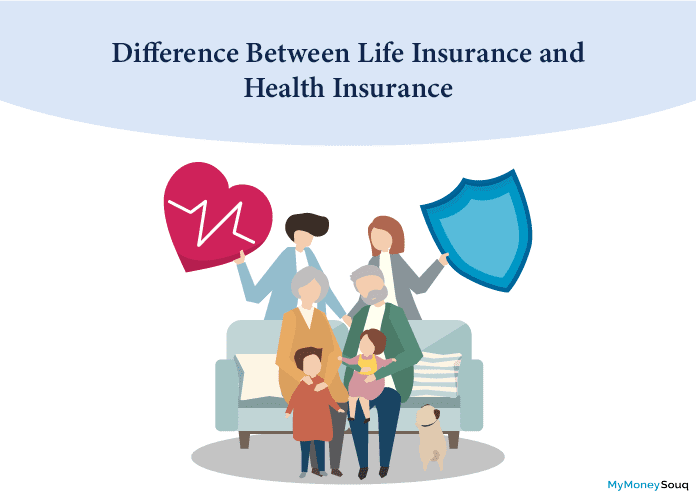
Difference Between Life Insurance and Health Insurance

Each type of insurance serves a different purpose. The intention is to safeguard and provide safety to the insured and their family members against the uncertainties of life. Building a risk-managed portfolio is important, which includes various insurance products for protection and safety.

Choosing the Right Insurance

Selecting the right insurance can be confusing due to the available options. Factors such as time of insurance, individual goals, sum assured, affordability, and plan flexibility should be considered when making a decision.

HOT READ: 10 Best Insurance Companies in Dubai You Need to Try in 2026

Life Insurance Policy

Definition

A life insurance policy provides financial protection for dependents and family members in the event of the policyholder’s death. Premium amounts are paid to create this financial security.

Types of Life Insurance Policies

1. Whole Life Insurance

The whole life insurance plan has a fixed premium and offers a sum assured to the nominee. It is a low-cost plan with consistency and no risk. There is also an option to choose a loan under this plan.

- Advertisement -

2. Universal Life Insurance

The universal life insurance policy is similar to whole life insurance but with higher costs. It offers a death benefit to the nominee and has flexible plans with added investment risks.

3. Term Life Insurance

Term life insurance is a simple and popular type of insurance. It is affordable and flexible, covering life insurance for a specific period of time. It is a risk-managed tool with no significant maturity benefits.

DON’T MISS: Top 11 Insurance Mobile Apps In New York (2026)

Health Insurance Policy

Definition

A health insurance policy provides financial assistance for medical emergencies. It covers medical expenses and treatments. The policyholder pays a premium in exchange for coverage.

Types of Health Insurance Plans

1. Personal Health Insurance

Personal health insurance covers individuals and provides coverage for critical illnesses, hospital expenses, and medical complications.

2. Family Health Insurance

Family health insurance covers the entire family’s medical needs, including illness, emergencies, and hospital expenses.

3. Senior Citizen Health Insurance

Senior citizen health insurance is designed for individuals above the age of sixty. It caters to their specific medical requirements and provides quality medical services.

- Advertisement -

Conclusion

Both life insurance and health insurance serve different purposes. The right choice depends on individual requirements. It is important to make an informed decision and purchase the best insurance plan.